
 English
  Español
  Français
  Português
  Deutsch
  日本語
日本語  한국어
한국어  Türkçe
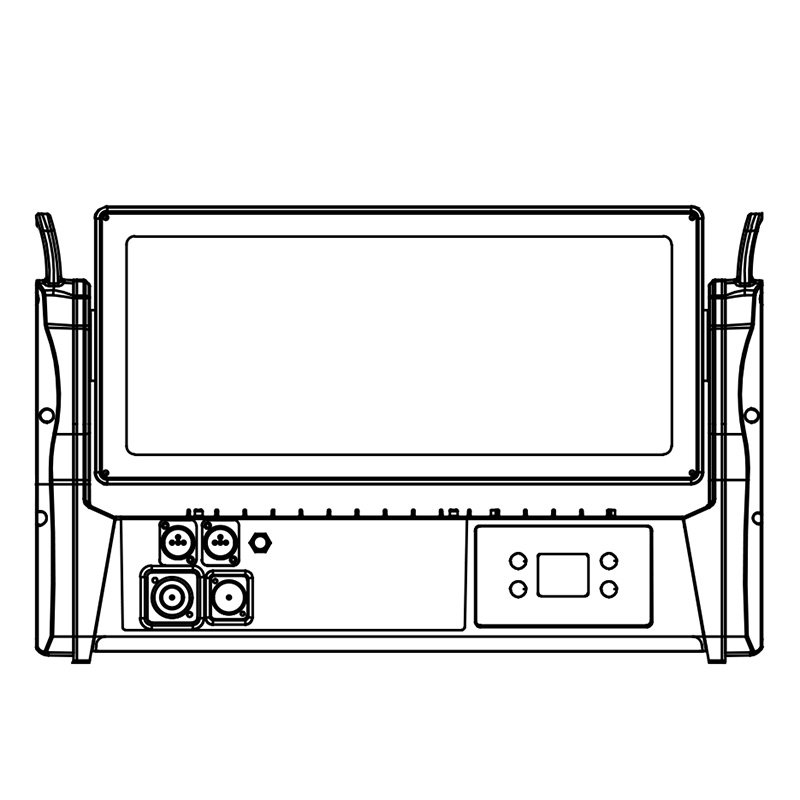
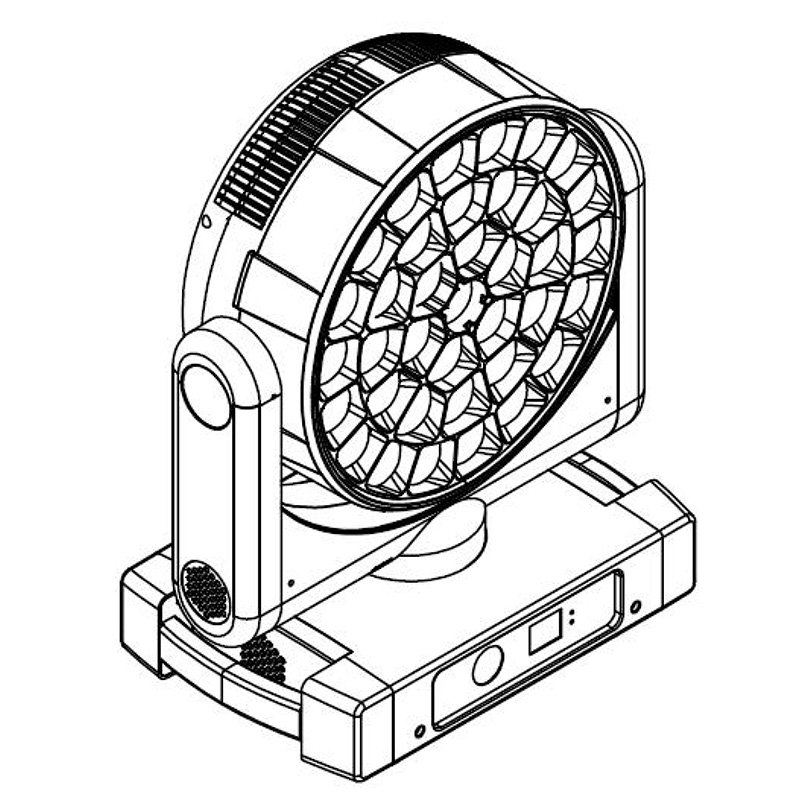
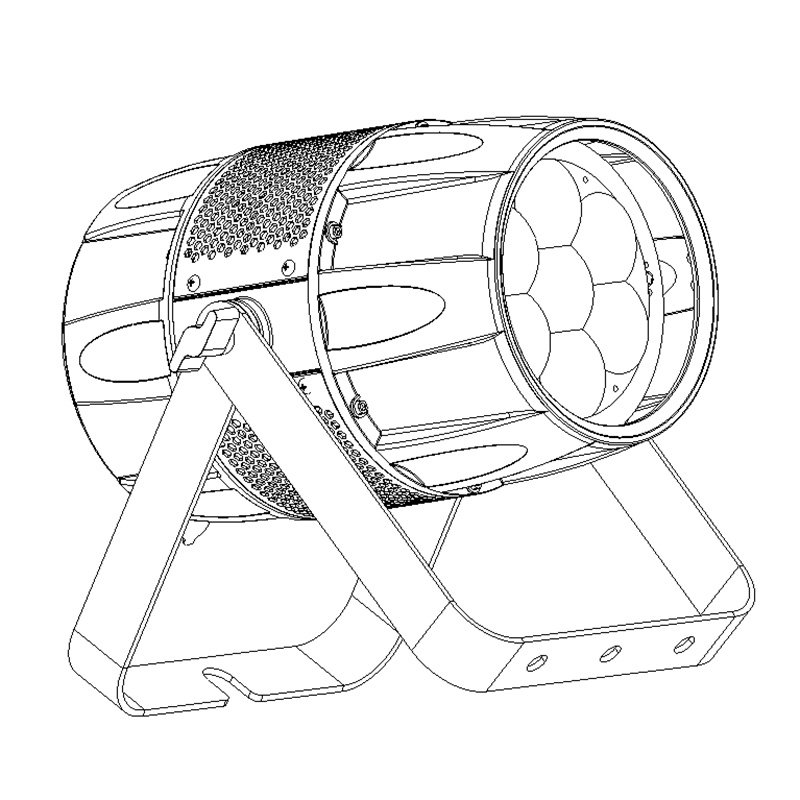
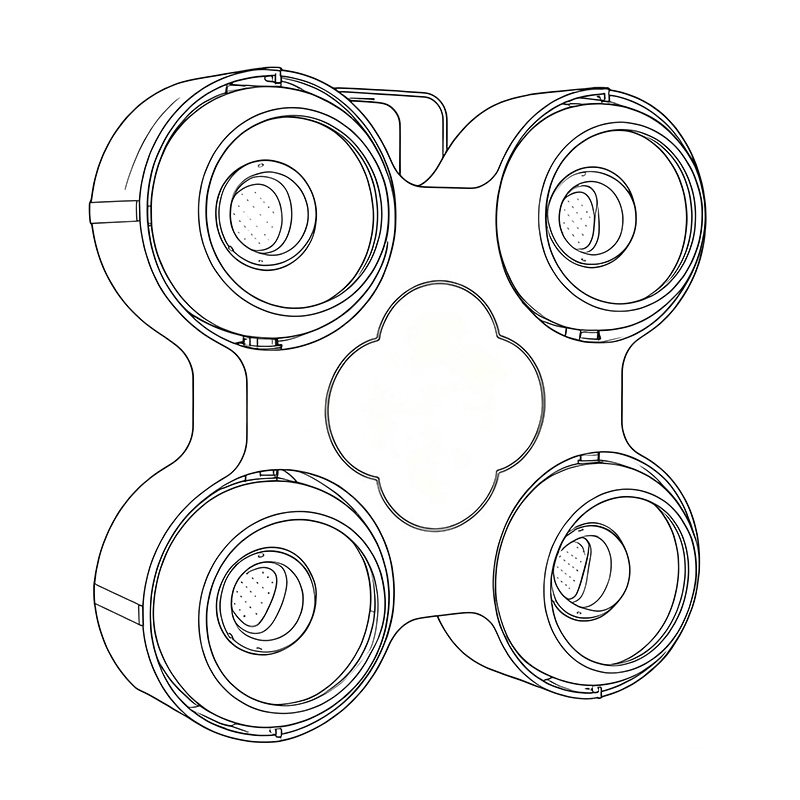
Quick answer: Beam angle measures the central cone between points where luminous intensity falls to 50% of the maximum. Field angle measures the wider cone at the 10% points. Use either full angle with throw distance to calculate its projected diameter, but do not treat that diameter as uniformly bright coverage. Compare the resulting geometry with lux data and the fixture’s photometric distribution.
For a buyer, the distinction affects more than terminology. It changes the diameter used in a coverage plan, the overlap between fixtures and the way two models should be compared. A quoted angle is useful only when the supplier identifies what it represents, the optical or zoom position used and the photometric conditions behind it.
What Is Beam Angle?
The Illuminating Engineering Society definition of beam angle is the angle between the two directions where intensity is 50% of the maximum, measured in a plane through the nominal beam centreline. It is a full included angle, not the angle from the optical axis to one edge. The latter is the half-angle used in coverage calculations.
This 50% boundary describes the stronger central part of a distribution. A small beam angle generally concentrates the projected light into a smaller area, which can support a higher centre illuminance and a tighter aerial effect. It does not, by itself, state total luminous flux, edge quality, colour uniformity or how much usable light exists outside that boundary.
For a non-symmetrical output, one angle may be insufficient. Photometric data can state horizontal and vertical beam angles in two perpendicular planes. A single circular diameter calculation assumes rotational symmetry and a target surface perpendicular to the optical axis.
What Is Field Angle?
The IES definition of field angle uses the same measurement principle at the 10%-of-maximum intensity points. Because the intensity must fall farther before reaching 10%, field angle is normally wider than beam angle for the same distribution. It represents the lower-intensity outer field, not a hard physical aperture or a promise of evenly usable illumination.
Field angle matters when a wash must blend into adjacent coverage, when spill reaches scenery or screens, and when a profile field needs to be evaluated for uniformity and edge control. The term should not be confused with mechanical aperture, iris diameter, a marketing “spot angle,” or a zoom range whose measurement threshold is not stated.
Beam Angle vs Field Angle: The Practical Difference
Procurement rule: if a datasheet says only “angle” or “zoom,” ask whether the values are beam angle, field angle or another manufacturer-defined measurement.
How to Calculate Beam Diameter from Beam Angle and Throw Distance
For a symmetrical cone projected perpendicular to a flat target, use this geometric relationship:
Beam diameter and throw distance use the same length unit. The angle is the full included angle in degrees. Divide it by two because the right triangle runs from the optical axis to one edge. Use the same equation with a verified field angle when you need the nominal 10% field diameter.
Example: a 20° beam at a 10 m throw gives 2 × 10 × tan(10°) = 3.53 m. If a target is angled relative to the optical axis, the projected shape becomes an ellipse; this simple circle calculation no longer describes both axes.
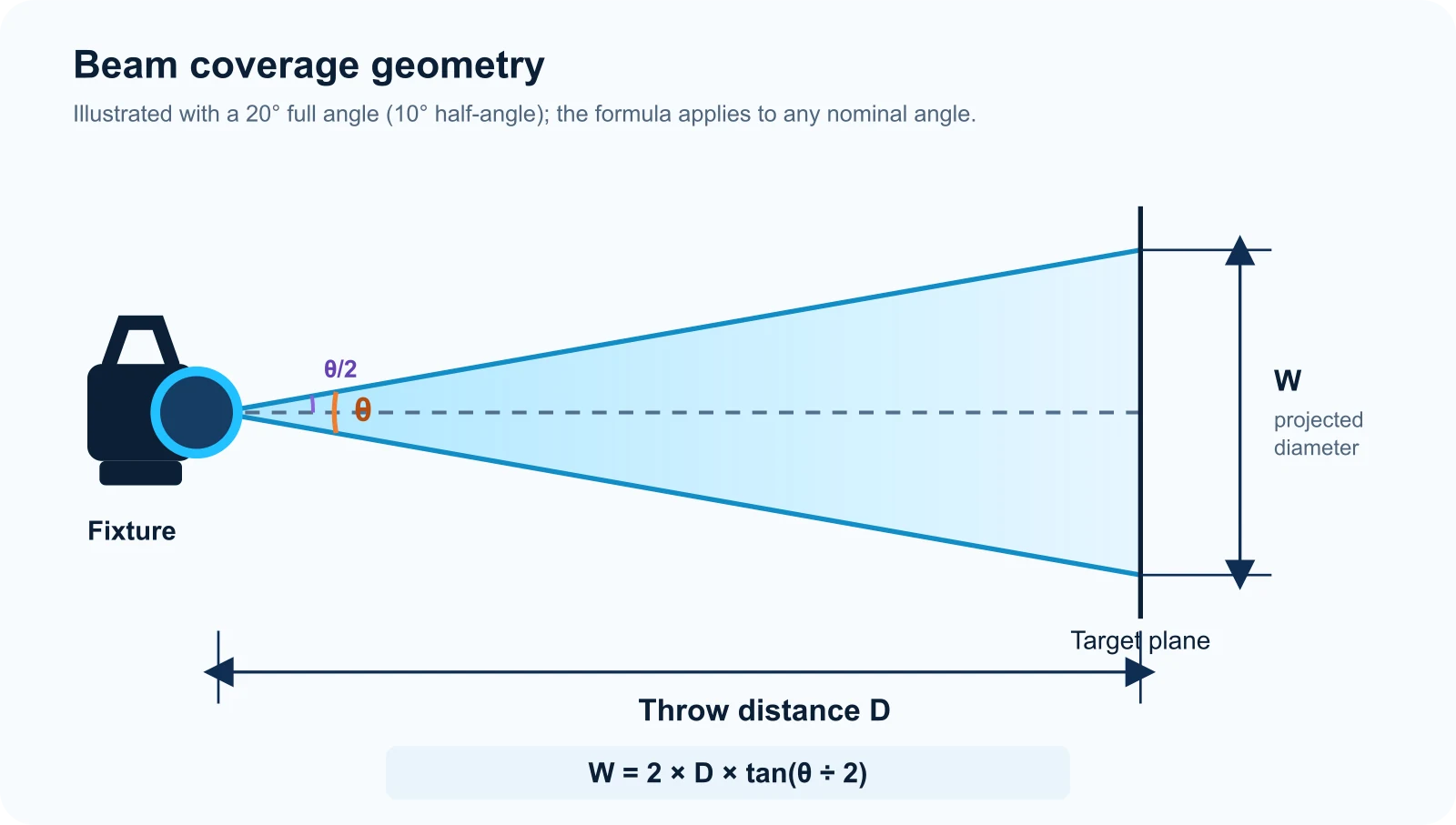
Important: this is geometric coverage based on nominal angle, not a prediction of illuminance or usable edge intensity. The entire projected circle does not have equal brightness.
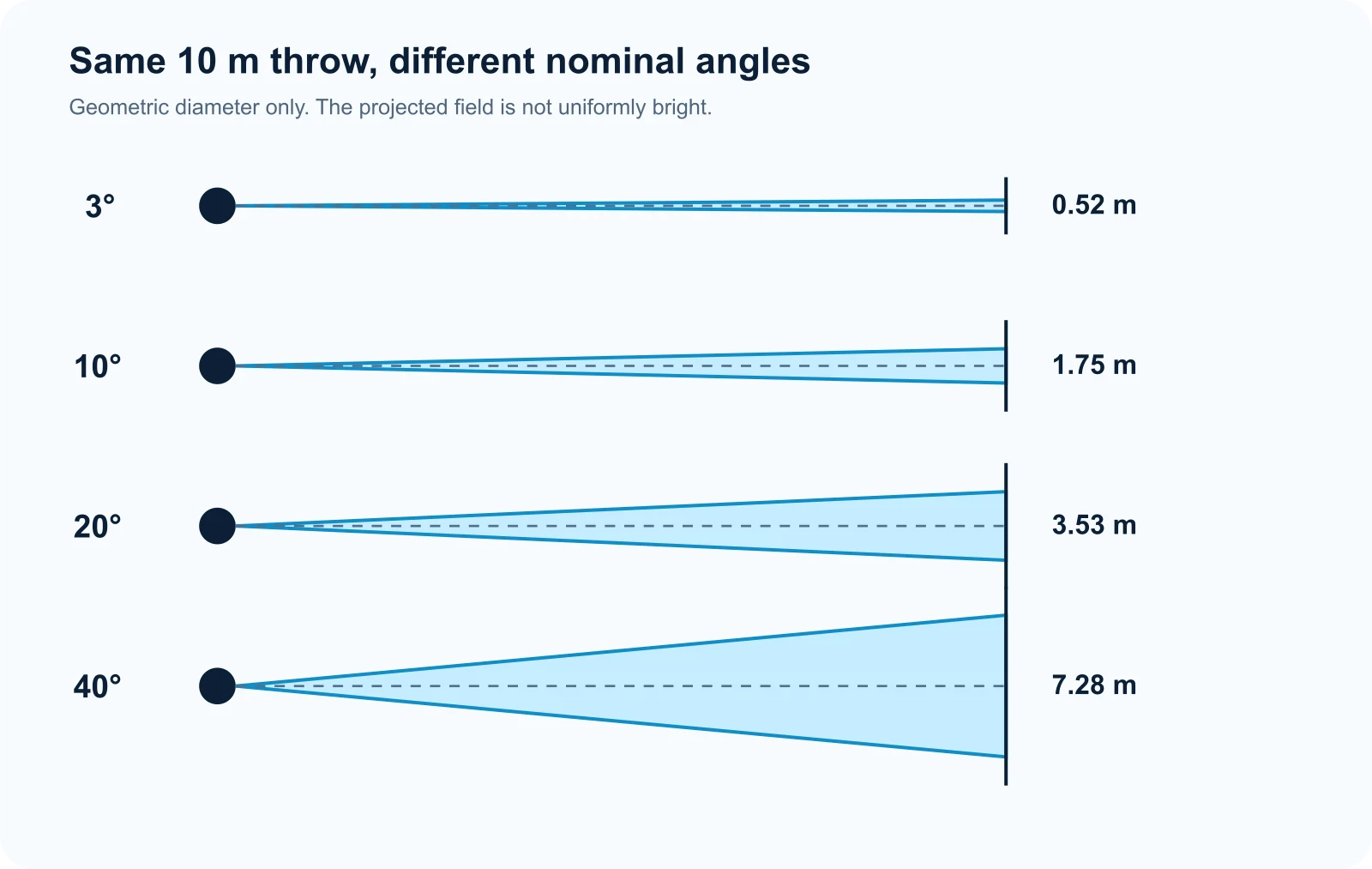
What 3°, 10°, 20° and 40° Actually Mean on Stage
3°: narrow aerial effect
At long throws, a very narrow beam stays geometrically compact. It is often considered for concentrated aerial effects and visible shafts in haze. Confirm focus, beam consistency and lux at the real distance.
10°: tight target area
A 10° angle gives a 1.75 m nominal diameter at 10 m. Depending on optical design, it can suit a tighter spot, a narrow wash position or a larger beam effect.
20°: medium coverage
A 20° angle produces about 3.53 m at 10 m. It can support general spot or wash work when its field quality, output and optical tools match the cue.
40°: broad coverage
A 40° angle reaches about 7.28 m at 10 m. It is useful for broad washes and shorter-throw area coverage, subject to output, uniformity and spill control.
These values are not rigid fixture-category boundaries. A Beam, Wash, Spot or Profile name describes a role and feature set, while the actual distribution depends on the source, reflector, lens train, focus, frost, zoom calibration and measurement convention.
How to Read a Moving Head Zoom Range
A specification such as 7°–42° states the minimum and maximum published angles. Its simple optical zoom ratio is 42 ÷ 7 = 6:1. At the same throw, the wide end covers a much larger diameter. The narrow end usually produces greater centre illuminance because light is concentrated, but this must be verified with photometric data at both settings.
AOLAIT’s AL600MLS 600W LED Profile product page and manual both publish 7°–42° zoom. The profile application also depends on focus, framing shutters, field uniformity and projection quality. The AL3740WR 37×40W LED Wash publishes 7°–50° zoom; its manual identifies the photometric readings as measured at the 7° position. That qualifier is essential.
The AL250LB 250W LED Beam provides a different example: a published 2° beam for a narrow role rather than a broad zoom range. The product category and the angle together help describe the intended effect, but buyers still need output and distribution evidence.
Document conflict to resolve: the current AL550RX product page separates Beam mode at 1.6°–22° and Spot mode at 2.9°–44°. Its linked manual states only a combined 1.6°–44° beam-angle range. Do not use the combined span as if every mode shares it. Request current, mode-specific optical and photometric confirmation.
Why Beam Angle and Lux Must Be Read Together
Lux measures illuminance at a surface. A narrower beam can produce higher centre illuminance without producing more total luminous flux, because the optical system concentrates light into a smaller projected area. Conversely, a wide setting may cover more stage while reducing centre lux. Wattage cannot replace either measurement: electrical or source power does not reveal optical efficiency, distribution or delivered light.
For an ideal point source measured on-axis, illuminance follows an inverse-square relationship: double the distance and illuminance becomes approximately one quarter. Real stage fixtures can depart from the simple model because of near-field geometry, focus, zoom, lens losses, measurement alignment and nonuniform distributions. Use the law as a reasonableness check, not as a substitute for measured photometry at relevant distances.
What Photometric Data Should a Buyer Request?
A single statement such as “XX,XXX lux @ 5 m” is not a complete optical comparison. Ask for:
- beam angle and field angle, with the measurement thresholds identified;
- centre illuminance at defined distances;
- the zoom, focus, frost, iris, gobo and prism settings used;
- the white, CCT, colour mix or colour-wheel position used;
- photometric distribution curves or an iso-illuminance chart;
- horizontal and vertical data for asymmetrical distributions;
- test distance, voltage, ambient conditions and instrument/method;
- source operating state, calibration and any output mode;
- model, firmware, sample status and test-report date.
These records allow the purchasing team to compare like with like and prepare a meaningful sample-acceptance test. A future guide can address how to read a complete stage-lighting photometric report; this page keeps the focus on angle, coverage and selection.
Which Optical Specifications Matter for Beam, Wash and Profile Fixtures?
If the fixture roles themselves are still being defined, use the moving-head Wash vs Spot guide, the Beam moving-head optics guide and the profile moving-head buyer guide before comparing models.
Questions to Ask a Stage Lighting Supplier Before Buying
- Is the published angle a beam angle, field angle or another measurement?
- Is it the full included angle, and is the output symmetrical?
- What centre lux was measured at 5 m, 10 m or the project’s actual throw?
- At which zoom, focus, colour and effects settings was the lux measured?
- Can you provide the current photometric chart or test report?
- How uniform is colour and illuminance across the field?
- What are the measured, usable limits of the zoom range?
- Are Beam, Spot and Wash modes measured and documented separately?
- Can a sample be tested against agreed coverage and illuminance criteria?
Frequently Asked Questions
What is the difference between beam angle and field angle?
Beam angle uses the 50%-of-maximum intensity points. Field angle uses the wider 10% points. Both are full angles through the nominal beam centreline.
How do I calculate beam diameter from beam angle?
Use diameter = 2 × throw distance × tan(full angle ÷ 2). Keep the distance and diameter in the same unit.
Does a narrower beam always look brighter?
Not always. A narrower distribution can raise centre illuminance by concentrating light, but source output, optical efficiency, haze, colour state and viewing conditions also affect appearance.
What beam angle is best for a moving head?
There is no universal best angle. Select from the target size, throw, visual role, required illuminance and the fixture’s measured distribution.
How does throw distance affect beam size?
For a fixed angle, geometric diameter grows in direct proportion to throw distance. Doubling the throw doubles the calculated diameter.
Is zoom range the same as beam angle?
No. Zoom range describes the available minimum-to-maximum optical settings. The supplier must still state whether those endpoints are beam angles, field angles or another convention.
Why should buyers ask for a photometric report?
It connects nominal angles and lux claims to distribution, distance, settings and test conditions, making cross-model comparison and sample acceptance more defensible.
Request optical data for your project
Send AOLAIT your throw distance, target diameter or coverage, venue type, indoor or outdoor conditions, preferred Beam, Wash, Spot or Profile role, desired zoom range, required illuminance and quantity. Ask for matching optical specifications and current photometric data before final model selection.
Technical references: IES beam angle, IES field angle and IES centre-beam intensity. Product examples link to the current AOLAIT pages; confirm the selected model and document revision before ordering.